Lalit Shastri
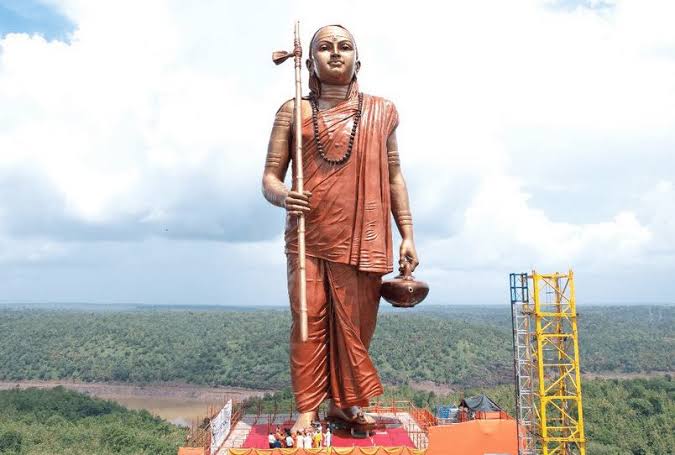
In the serene embrace of the Himalayas, bound by the Sanatan faith and traditions, lies a profound connection between the southern Indian State of Kerala, where land meets the deep sea, and the lofty Himalayan peaks of the North. The enigmatic presence of Kerala’s priests in high Himalayan temples, such as the most revered Badrinath and the Pasupatinath temple in Nepal, traces the origin of this tradition to its protagonist in none other than Adi Shankaracharya.
The narrative begins with the wandering footsteps of Adi Guru Shankaracharya from Kerala, whose journey etched the contours of tradition across the Himalayan landscape. Adi Shankaracharya emerges as the fitting archetype, his timeless legacy intertwining with the spiritual fabric of these sacred regions.
Echoes of Shankaracharya’s thought, philosophy, message, and influence resonate through the annals of time, affirmed by the enduring testament of his disciples. Among them, the figure of Sureshwaracharya stands, casting light upon the enigma of Shankara’s existence.
Further substantiating this narrative are the hallowed Ashrams bedecked like jewels across the expanse of India, each bearing the imprints of Shankaracharya’s wisdom.
Amidst the sprawling diversity of these Ashrams, a remarkable unity emerges—the manuscripts attributed to Shankaracharya, housed within these Mathas, stand as silent witnesses to the undying spirit of a single master.
A stylistic analysis unveils yet another layer of evidence, illuminating the unity of thought coursing through the veins of Shankaracharya’s writings. The unmistakable imprint of a singular pen, resonating across at least twenty compositions, speaks volumes of a profound legacy.
Delving deeper into the annals of history, the origins of Shankaracharya unravel in the sun-kissed village of Kaladi, nestled within the verdant embrace of Kerala. Born to devout parents, his childhood marked by an innate pull towards the ascetic life, Shankaracharya emerges as the embodiment of spiritual quest.
The hagiographies paint a vivid picture of Shankaracharya’s journey—a journey that unfolds along the sacred rivers and hallowed sanctuaries of ancient India. From the tender age of eight, his destiny intertwined with the currents of Sannyasa, culminating in a fateful encounter with the venerable Govinda Bhagavatpada on the banks of River Narmada in Central India.
Shankaracharya’s life is woven with threads of uncertainty, where divergent narratives converge and diverge. Through the mists of time, his footsteps trace a path, spanning from the banks of the Narmada, to be precise Omkareshwar, to the sacred shores of Kashi and beyond.
Amidst the many tales, one truth remains unassailable—the indelible mark left by Shankaracharya upon the spiritual landscape of India. His legacy, enshrined in the orders of the Mathas that bear his name, continues to guide seekers on the path of Advaita Vedanta, illuminating the vast expanse and depth of human consciousness.
As the echoes of his teachings reverberate through the corridors of time, Adi Shankaracharya emerges not merely as a historical figure, but as a timeless beacon of wisdom—a luminary whose radiance continues to illuminate the path of seekers across the ages.
 Sanatan Mission